
Key Takeaways:
-
EV demand hasn’t disappeared—it’s shifted. While gas still dominates (56.2%), four in ten buyers are open to electrification, with hybrids the clear entry point (26.6%), not full EVs.
-
Price and operating costs drive decisions. Fuel savings are the top motivator (78%), while high upfront price remains the biggest barrier—one expected to ease gradually as incentives return and more affordable options enter the market.
-
Most EV barriers are information gaps, not product flaws. Concerns about batteries, charging, and repairs persist, despite strong real‑world performance and durability.
-
Once buyers go electric, they’re satisfied. 78% of Battery Electric Vehicles (BEV) owners say they’d choose electric again, signalling that hesitation is highest before purchase, not after.
-
Dealers who guide, reassure, and show readiness will win. Leading with value, EV knowledge, and visible service capability positions dealerships to capture demand as confidence and affordability improve.
The EV Shift
Canadian car buyers have not given up on electric, but momentum has shifted.
CARFAX Canada has been tracking EV market data and the consumer sentiment behind it for many years. Our latest research shows that consumers are curious about EVs, increasingly comfortable with hybrids, and cautious about cost, charging, and service access. At the same time, Canada’s EV environment has become a lot more complicated with shifts in incentives, supply, and affordability shaping buyer confidence.
EV sales in Canada may have hit a speed bump but the road ahead is long, and the opportunity belongs to dealers who understand what’s driving buyer behaviour now.
Where the EV market is today
Let’s start with the numbers.
In February 2026, BEV registrations accounted for just 7.1% of all new light vehicles, up from January (5.7%) and the same time last year (5.8%), but well below the peak of 17.8% we saw in December 2024. The recent increase in registrations is largely driven by the return of Federal rebates, which came into effect in mid-February.
Used EV prices are down 2.5% year-over-year. In March, the price gap between used EVs and gas-powered vehicles narrowed to its lowest level since the beginning of 2025. New EVs appear to be following a similar downward pricing trend.
What Canadians say they’ll buy next
When asked which fuel types they would consider for their next purchase, most shoppers still see gas as the best option. But interest in electrified vehicles remains meaningful, with 41% open to at least some form of electrification under the hood. Hybrid-electrics continue to represent the path of least resistance for many.
- Gas: 56.2%
- Hybrid electric: 26.6%
- Battery electric (BEV): 7.5%
- Plug‑in hybrid (PHEV): 7.0%
- Diesel: 2.1%
- Compressed natural gas: 0.3%
Interest in BEVs is highest among 35–44-year-olds‑ and lowest among those 65+. Men report higher interest than women. More importantly, 78% of current BEV owners say they would choose a BEV again. Once buyers make the switch, they generally don’t go back. Loyalty is strong with those that have taken the plunge, but the challenge is getting more buyers plugged in.
What’s pulling shoppers toward electric
When Canadians consider electric or hybrid electric vehicles, practicality drives the decision. Fuel savings are the strongest motivator by a wide margin (78%), followed by environmental considerations (52%). The focus on operating costs has been further reinforced now by volatility in global oil markets. Together, these drivers point to shoppers who are focused on everyday operating costs and long term impact, not new technology.
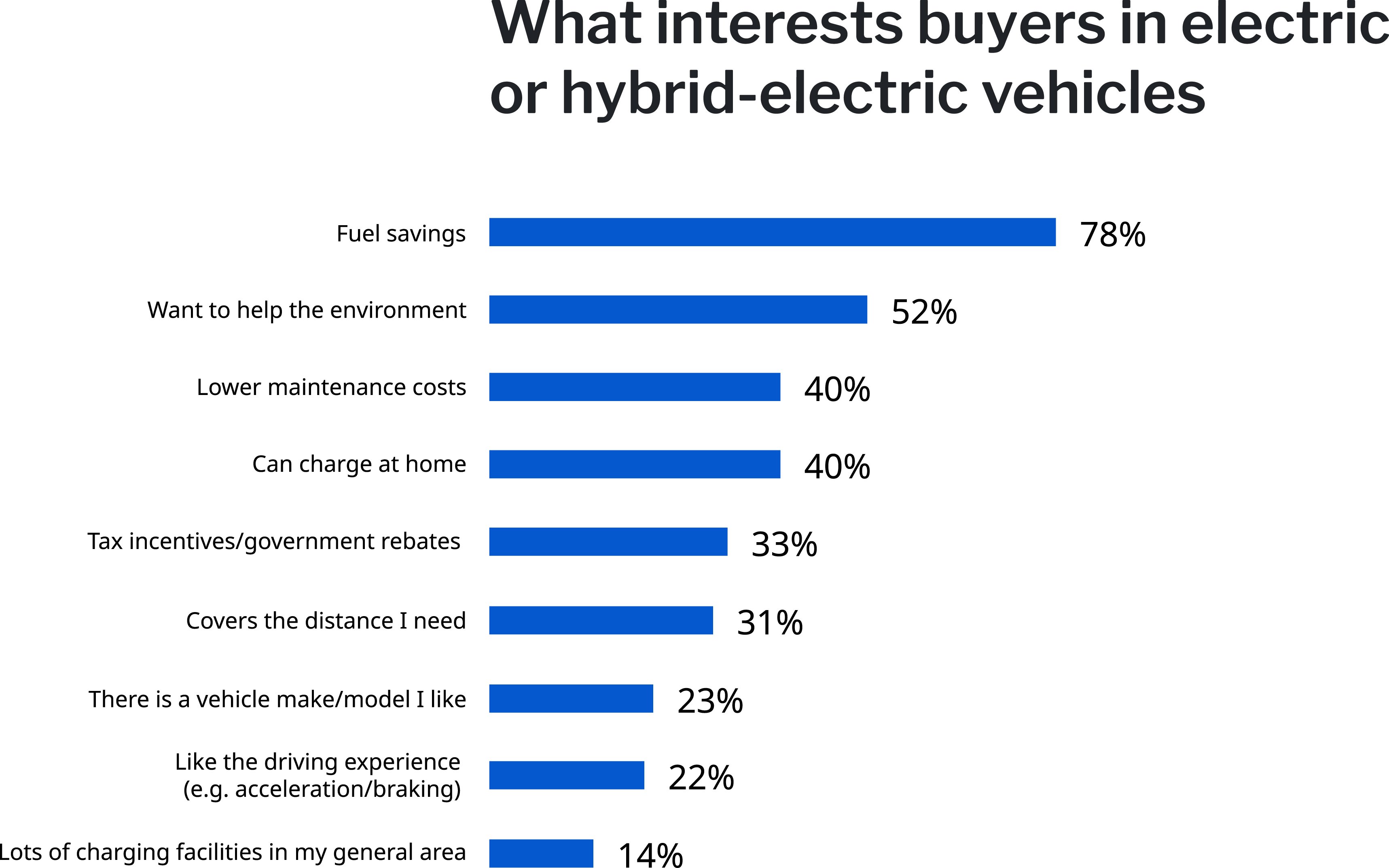
That same practical mindset shows up in how buyers think about ownership. Lower maintenance costs (40%) and the ability to charge at home both resonate strongly (40%), reinforcing the appeal of convenience and reduced effort over time. Incentives (33%) also play an important supporting role, highlighting how closely EV interest is tied to affordability.
Notably, fewer buyers are driven by brand loyalty or a particular model that caught their eye. Some of this may be tied to the waning popularity of Tesla, but it does suggest open-mindedness when it comes to EV choice and a chance to win buyers that may not have any preexisting relationship with your store or brand.
What’s holding buyers back – and why it matters less today
There’s no shortage of barriers keeping EV buyers on the sidelines. The good news is that these barriers are starting to crumble.
For Canadians, the biggest hurdles to going electric are still cost and confidence. High purchase prices top the list, followed closely by concerns about battery lifespan, range, and charging time. Many shoppers still worry about whether the technology fits their budget and daily driving needs.
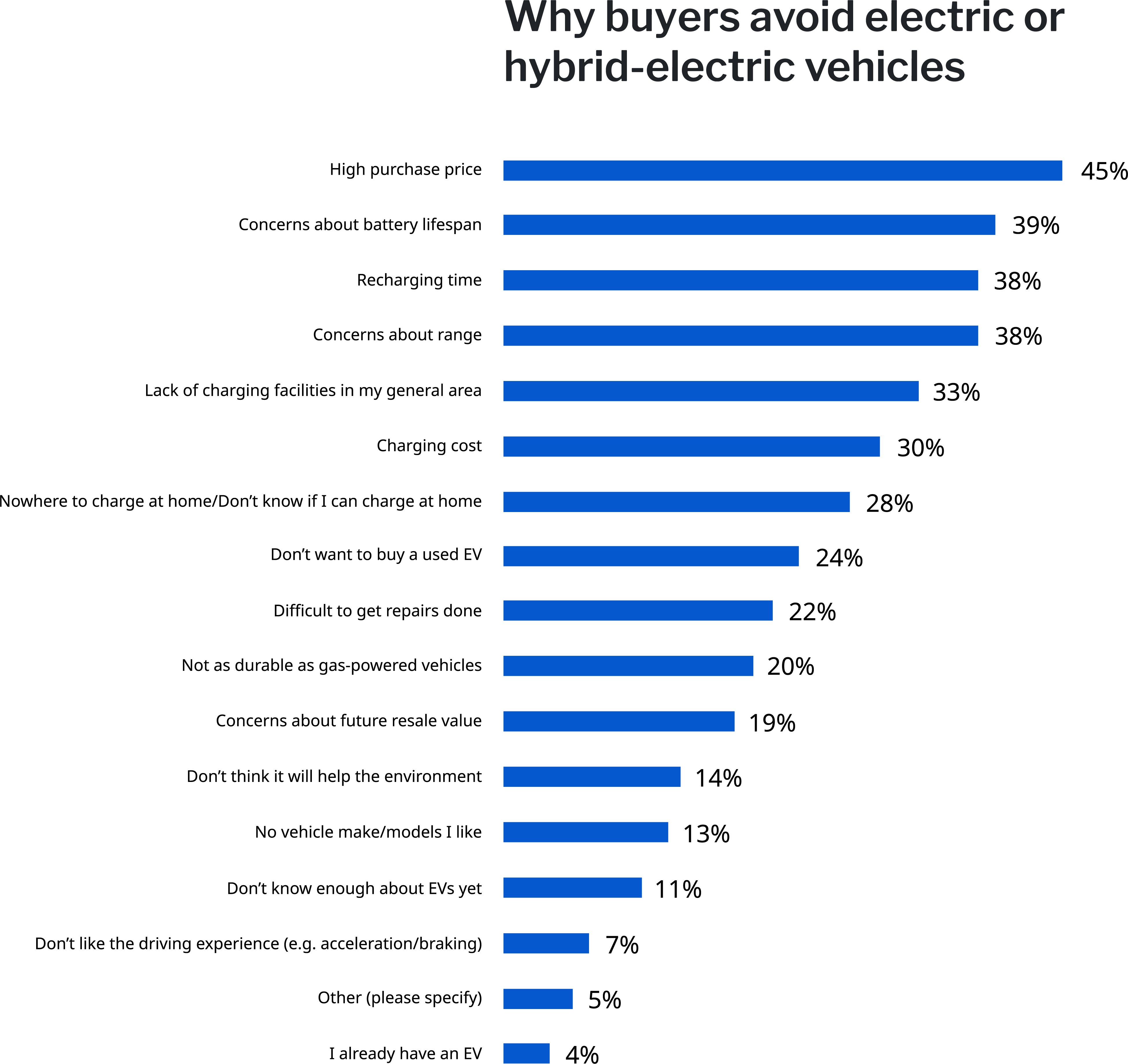
Battery lifespan is a common friction point (39%), but real‑world data shows this should be less of a worry, with average battery degradation around, 20 years or more before reaching end‑of‑life.
Perceived charging access, both at home and in public, continues to influence hesitation, as do concerns about charging costs. Just as important, 22% of shoppers worry about being able to get repairs done, reflecting uncertainty about service availability and expertise. Other factors, such as reluctance to buy a used EV or doubts about durability and resale value, affect smaller segments but can still stall purchase decisions.
Taken together, these concerns point less to permanent obstacles and more to friction points that are already beginning to ease as infrastructure improves and misconceptions are cleared. For dealers, these barriers highlight where reassurance, education, and visible EV readiness can make the biggest difference.
What this means for your dealership
EV demand hasn’t stalled. It has become more selective, more price‑sensitive, and more dependent on confidence. Dealers that win in this environment are the ones that make electrified vehicles feel practical, approachable, and low‑risk.
Lead with value, not technology
Buyers are motivated by fuel savings, lower maintenance, and everyday convenience. Frame electrified vehicles around total cost of ownership, not features.
Use hybrids as the bridge
Many shoppers are not ready for BEVs, but they are open to electrification. Hybrids are often the easiest way to keep those buyers moving forward.
Be the expert buyers are looking for
Misinformation around batteries, charging, and repairs is holding people back. Clear explanations, realistic expectations, and confident answers build trust quickly. Staff who have driven EVs can speak from real world experience and paint a much better picture of what buyers can expect.
Make EV readiness visible
Service capability matters. For dealerships with service departments, now is the time to actively promote the team and their EV expertise. Highlight EV‑trained technicians, high‑voltage safety certification, and repair readiness to remove a major purchase barrier for hesitant buyers.
Meet cautious buyers where they are
This is not about pushing EVs harder. It’s about guiding buyers through their options and helping them choose what fits their lifestyle today. For many interested in electrification, this will mean starting with a hybrid.
Laying the groundwork for future success
While price remains the biggest barrier for many buyers today, that pressure is expected to ease over the next few years as federal incentives return and more affordable EV options gradually enter the market. As new EV pricing improves, used EVs are also likely to become more accessible, widening the pool of potential buyers.
Building capability, confidence, and flexibility today positions dealerships to benefit as affordability improves and demand follows.
What's up next
The hesitation Canadians are expressing mirrors what played out in the market last year. When federal EV rebates were paused in January 2025, adoption slowed almost immediately.
Conditions are gradually improving. Canada’s public charging network grew 24% year-over-year, reaching 33,767 public charging ports in 2025, and federal rebates returned in February 2026, again offering up to $5,000 for BEVs and $2,500 for Plug-in Hybrid Electric Vehicles (PHEVs). Canada has also reopened limited access to Chinese‑built EVs under a 49,000‑vehicle annual quota at a 6.1% tariff, a move that will improve affordability over time and help to breakdown that number one barrier – price tag. Together, these shifts help explain why buyers remain cautious today, but also why the groundwork is being laid for renewed EV interest.
Share your thoughts